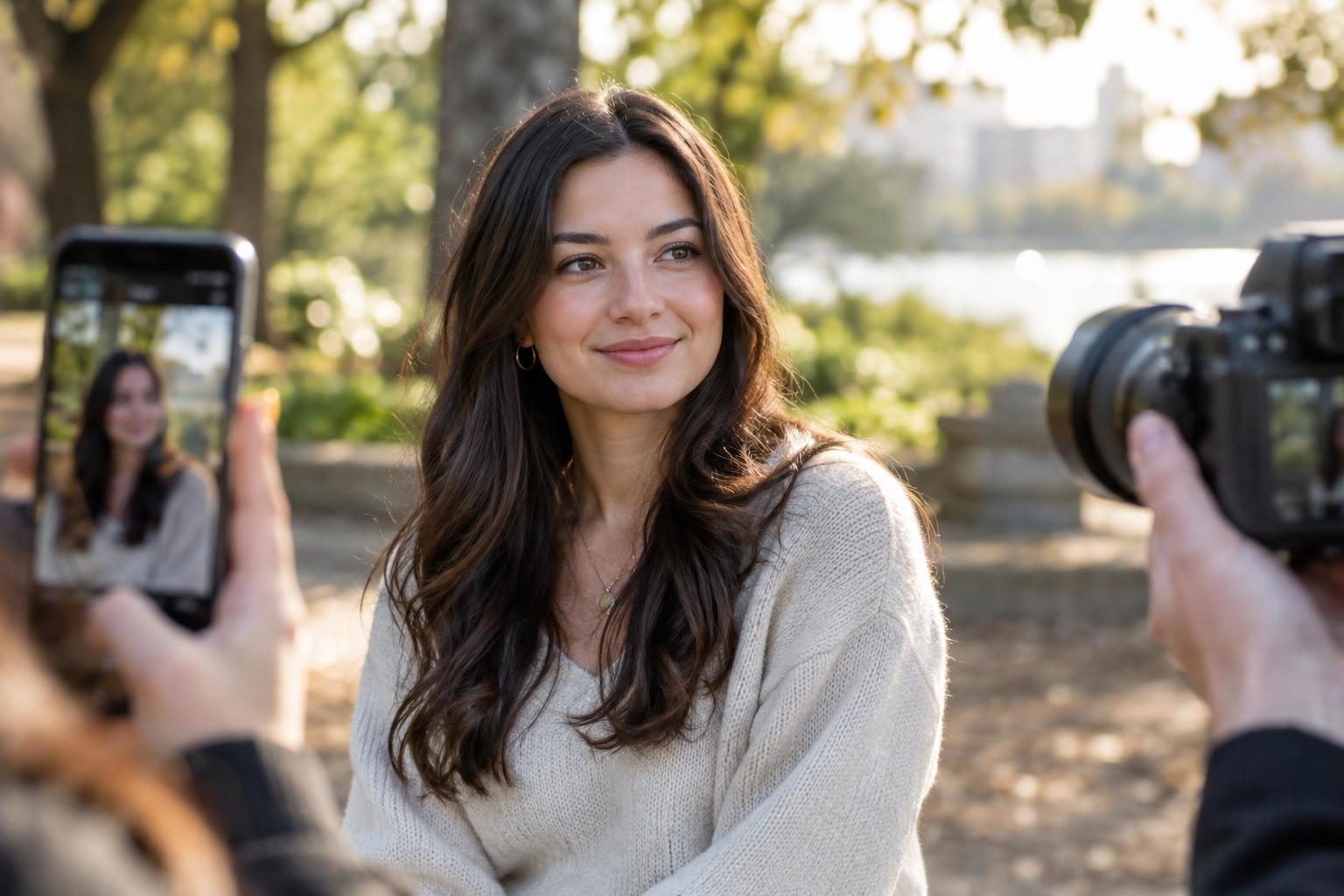
Start with what the portrait needs to show
Aperture is the size of the lens opening during an exposure. It is written as an f-number: f/1.8 is a wider opening than f/5.6. A wider aperture lets in more light and generally gives you a shallower depth of field—the range of distances that appear acceptably sharp. That can help a person stand apart from the background, but it can also leave parts of their face soft.
Before choosing a number, decide what matters in the frame. For a close headshot against a distracting backdrop, you might want pronounced separation. For a portrait that shows someone in a workshop, garden or favorite room, keeping some of that setting recognizable may tell a better story. Aperture is a way to support that choice, not a rule that every portrait should follow.
Use wide apertures with a clear focus plan
If your lens allows it, an aperture around f/1.8 to f/2.8 is a starting point for a softly blurred background. It can be useful in limited light, too. At close portrait distances, however, the sharp zone may be thin. If the person turns their head, the nearer eye might look sharp while the farther eye does not. Focus on the eye you most want the viewer to notice, and review a magnified image rather than relying only on the camera’s small preview.
A wide aperture does not blur every background equally. Blur also depends on your distance from the person, their distance from the background, focal length and framing. Moving your subject a few steps away from a wall can make a noticeable difference without changing lenses. If you are struggling to keep the face sharp, try stopping down a little before giving up on the composition.
Stop down when detail and context matter
For a head-and-shoulders portrait, f/2.8 to f/4 can offer a useful balance between separation and a more forgiving focus zone. If the person is leaning forward, wearing a brimmed hat or holding something near their face, a smaller opening may help keep the important details together. For an environmental portrait, f/5.6 or f/8 can make it easier to read both the person and the place.
These ranges are starting points, not guarantees. A tightly framed portrait can still have shallow depth of field at f/4, while a full-length portrait may show plenty of background detail at f/2.8. Different camera formats can also produce different depth of field when you adjust your position or lens to keep the same framing. Judge the photograph you are making rather than treating an f-number as a fixed visual effect.
Balance aperture against shutter speed and ISO
Stopping down reduces the light reaching the sensor. To maintain a similar brightness, you may need a slower shutter speed, a higher ISO or more light. For a person who shifts expression or posture, too slow a shutter speed can make the face look blurred even when focus was accurate. Ask your subject to pause, look for steadier light or raise ISO if those choices serve the portrait better than opening the aperture further.
In changing light, aperture-priority mode can be convenient: you choose the depth-of-field direction, and the camera adjusts the shutter speed. Keep checking that the shutter speed remains suitable for the person’s movement and your ability to hold the camera steady. If you use a flash, remember that your camera and flash may limit which shutter speeds you can use together. Whatever the lighting setup, make a test frame and inspect the face before taking a long series.
Try a controlled aperture exercise
Place one person a comfortable distance from a background with visible details, such as shelves or foliage. Keep your camera position, framing and subject position as consistent as you can. Make portraits at several apertures your lens offers—for example, f/2, f/2.8, f/4 and f/5.6—adjusting shutter speed or ISO as needed for similar brightness. Focus on the same eye each time, and check that motion blur has not affected the comparison.
Compare the images at both full-frame view and a closer view of the face. Notice when the background becomes too distracting, when it loses useful context and when the facial details look the way you intended. Then move the person farther from the background and repeat a few frames. This shows why an aperture choice works best as part of a larger decision about light, distance and composition.