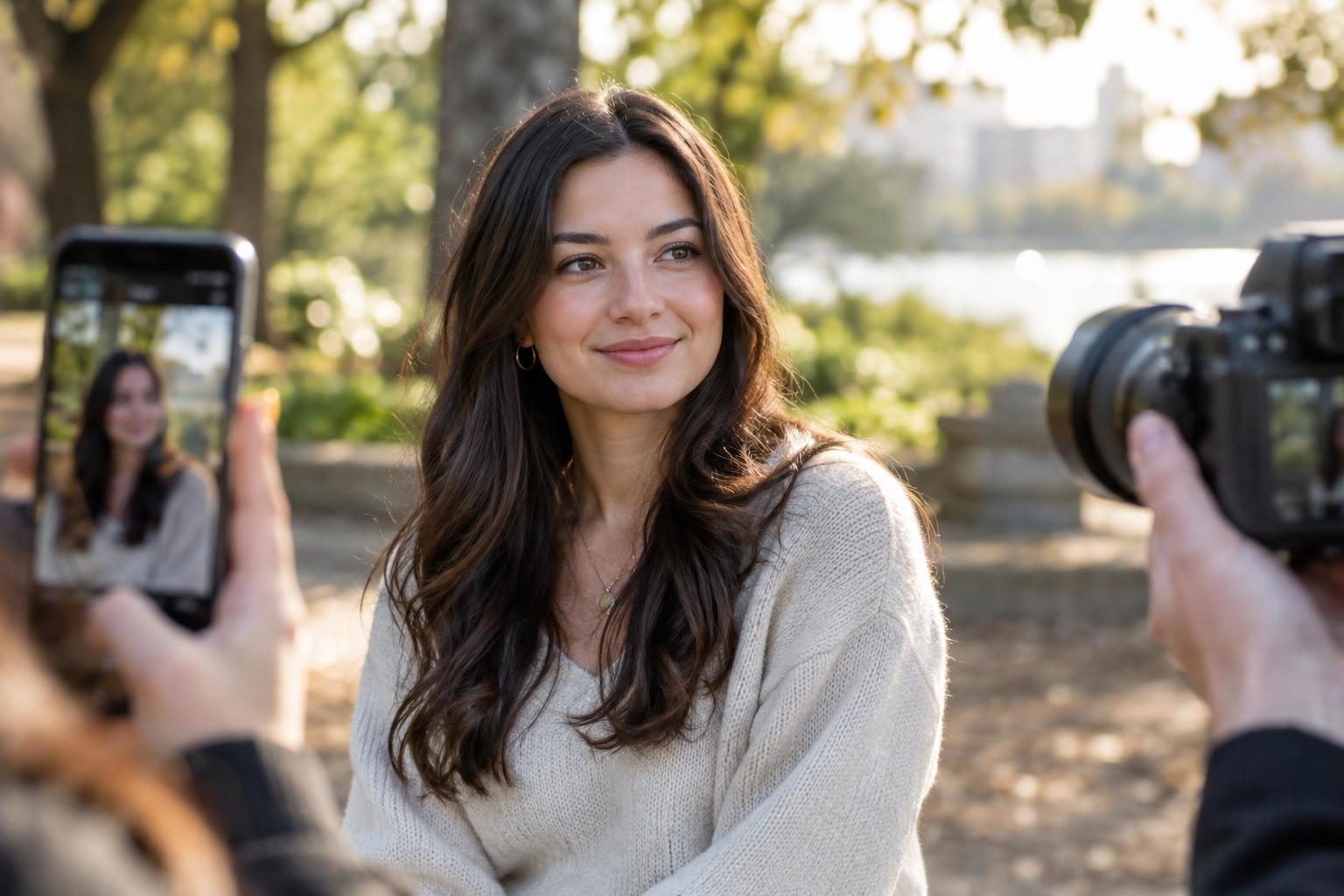
Decide what should look sharp
The right shutter speed depends less on the label “portrait” than on what the person is doing. A seated subject turning their head, a child running toward the camera, and a dancer crossing the frame all move differently. Start by deciding where sharpness matters. In many portraits, clear eyes are the priority. In others, a sharp face with a blurred hand conveys a gesture better than a completely frozen frame.
Shutter speed controls how long movement can register during an exposure. A faster speed gives the subject less time to shift position and is more likely to freeze a fleeting expression. A slower speed allows movement to appear as blur. Neither result is automatically a mistake: the useful question is whether the blur supports the portrait you intended.
Use starting points, then check the result
For a person standing and talking, 1/125 or 1/250 second is a reasonable place to begin. If they are walking, try around 1/500 second; for quick turns, jumping, or energetic play, start near 1/1000 second. These are starting points, not guarantees. A subject moving across the frame may blur more visibly than one moving at the same pace toward you, while a hand can move faster than the person’s face.
Your camera and lens movement matter too. A long focal length or a moving camera can make blur more noticeable. Image stabilization can help with camera shake, but it cannot stop the subject from moving. If the face looks soft, inspect it at a useful magnification and ask whether the cause is motion, missed focus, or shallow depth of field before changing the shutter speed.
Make a short test sequence whenever the pace changes. Photograph a few frames, review the eyes and edges of the face, and raise the shutter speed if unwanted blur remains. If the frames look sharp but lack a sense of movement, you can try a slower speed deliberately rather than treating maximum sharpness as the only goal.
Balance shutter speed with light and depth of field
A faster shutter speed lets in less light. To maintain a usable exposure, you may need a wider aperture, a higher ISO, more light, or some combination of the three. A wide aperture can soften the background, but it also leaves less room for focus errors when a person moves. Raising ISO may add visible noise, yet a slightly noisy, sharp expression is often more useful than a clean frame with unintended motion blur.
In changing light, shutter-priority mode can help you hold a chosen speed while the camera adjusts other settings. Manual exposure with auto ISO is another option if you want to control both shutter speed and aperture. Check the resulting aperture and ISO rather than assuming the camera can always compensate; in dim light, it may reach a limit. If you use flash, consult your camera and flash settings for the available synchronization options. Flash can affect how motion appears, but ambient light and the flash duration both influence the final image.
Let motion become part of the portrait
Not every moving portrait needs to be frozen. For a walking subject, try following their movement smoothly with the camera at around 1/60 or 1/30 second. This technique, called panning, can leave parts of the person relatively clear while streaking the background. It takes practice, and you should expect some frames to miss. Choose a background with visible detail if you want the streaks to contribute to the picture.
You can also keep the camera still and use a slower exposure to show a twirling coat, moving hair, or a hand gesture. Give the subject a simple action they can repeat and decide which part of the portrait should remain recognizable. A slower shutter speed does not create a particular look on its own; the direction and pace of movement, the background, and the timing of your press all matter.
Practice with one repeatable action
Ask a willing subject to walk the same short path several times in consistent light. Keep your position and framing similar, and make one set at 1/250 second, another at 1/500, and another at 1/1000. Adjust aperture or ISO as needed to keep the exposure usable. Compare the face, hands, clothing, and background, not just the overall impression at thumbnail size.
Then repeat the action at 1/60 second while panning. You will have examples of both freezing and expressing motion under similar conditions. Note which speed gave you the look you wanted, along with the subject’s direction and pace. Those observations will help you choose a starting point for the next portrait—and adjust quickly when the person moves in an unexpected way.